Recipe
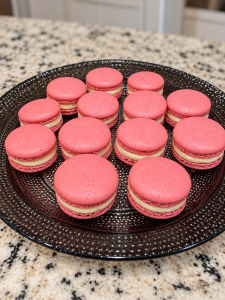
French Macarons
Making them is a baking project that invites you to slow down and pay attention—from whipping a glossy meringue to piping neat little circles. Watching those signature “feet” appear in the oven makes the effort especially rewarding.
Scale
Ingredients
- Macaron Shells
- 3 egg whites, at room temperature
- 5 tablespoons granulated sugar
- 1 1/3 cups powdered sugar
- 7/8 cup finely ground almond flour
- 1 teaspoon vanilla extract
- Gel food coloring, optional
- Vanilla Buttercream
- 1 cup butter, at room temperature
- 4 cups powdered sugar
- 2–3 tablespoons heavy cream
- 1 teaspoon vanilla extract
- Pinch of salt
Instructions
- Prepare the baking sheets.
- Line baking sheets with parchment paper or silicone baking mats. Fit a piping bag with a round tip.
- Sift the dry ingredients.
- Sift the almond flour and powdered sugar together. Discard any large, coarse pieces that won’t pass through the sieve. Set aside.
- Make the meringue.
- In a clean, dry mixing bowl, whip the egg whites on medium speed until foamy, about 1 1/2 minutes.
- Gradually add the granulated sugar while continuing to whip. Beat until glossy, stiff peaks form, approximately 3–4 minutes more, depending on your mixer.
- Add the vanilla and optional gel coloring during the final 30 seconds. The finished meringue should hold an upright peak.
- Fold the batter.
- Add the sifted dry ingredients to the meringue and gently fold with a spatula, scraping around the bowl and through the center.
- Continue until the batter flows off the spatula in a slow, continuous ribbon. You should be able to draw a figure eight without the ribbon breaking, and the lines should gradually settle back into the batter.
- Use the consistency as your guide rather than a fixed number of folds.
- Pipe the shells.
- Pipe quarter-sized circles onto the prepared baking sheets, leaving space between them. Hold the bag upright for even circles.
- Tap each tray firmly on the counter about 5 times to release trapped air. Pop any remaining visible bubbles with a toothpick.
- Rest the shells.
- Let the piped shells rest at room temperature for 45–60 minutes, or until the tops look matte and feel dry when lightly touched. Resting time may vary with humidity.
- Toward the end of the resting time, preheat the oven to 315°F. Keep the trays away from direct heat.
- Bake.
- Bake one tray at a time on the middle rack for 16–20 minutes. If your oven heats unevenly, gently rotate the tray once after the feet have formed and the shells have begun to set.
- The shells should feel stable when lightly nudged. If they still wobble, continue baking in 1–2-minute increments, checking frequently.
- Cool completely.
- Allow the shells to cool completely on the baking sheet before gently removing them from the parchment or mat.
- Make the buttercream.
- Beat the softened butter for about 3 minutes, until pale and creamy. Add the vanilla and salt, then beat for another minute.
- Gradually add the powdered sugar, mixing on low. Add 2 tablespoons heavy cream, then beat for about 2 minutes until fluffy. Add the remaining tablespoon of cream only if needed for a smooth, pipeable consistency.
- Fill and mature.
- Match shells of similar size. Pipe buttercream onto the flat side of one shell and gently sandwich with another.
- Place in an airtight container and refrigerate for 24–48 hours to allow the shells and filling to soften together. Let stand at room temperature for about 15–20 minutes before serving.
Connie’s notes
- Start with a grease-free bowl. Even a little oil or egg yolk can prevent the whites from whipping properly.
- Use finely ground almond flour. Coarse almond meal can leave the shells rough.
- Measure carefully. Spoon and level the dry ingredients. For greater consistency in future batches, record the ingredient weights from a successful batch.
- Add sugar gradually. This helps it dissolve into the egg whites and supports a stable meringue.
- Watch the batter closely. Undermixed batter holds stiff peaks after piping; overmixed batter spreads too quickly. Stop folding once the ribbon flows and slowly settles.
- Use gel coloring sparingly. It adds color without introducing as much liquid as liquid food coloring.
- Check the surface before baking. The shells should have a dry skin and should not stick to your fingertip.
- Use an oven thermometer. Small temperature differences can affect the feet, color, and texture.
- Avoid frequent oven opening. Repeatedly rotating the tray can cause temperature swings and disturb shells before they set.
- Let them mature. The refrigerated resting time helps create the tender, chewy texture that makes macarons so enjoyable.
Did you make it?
Ratings help other people decide whether to try it — and they tell me which recipes are worth doing more of. It takes ten seconds.
↓ Leave your rating